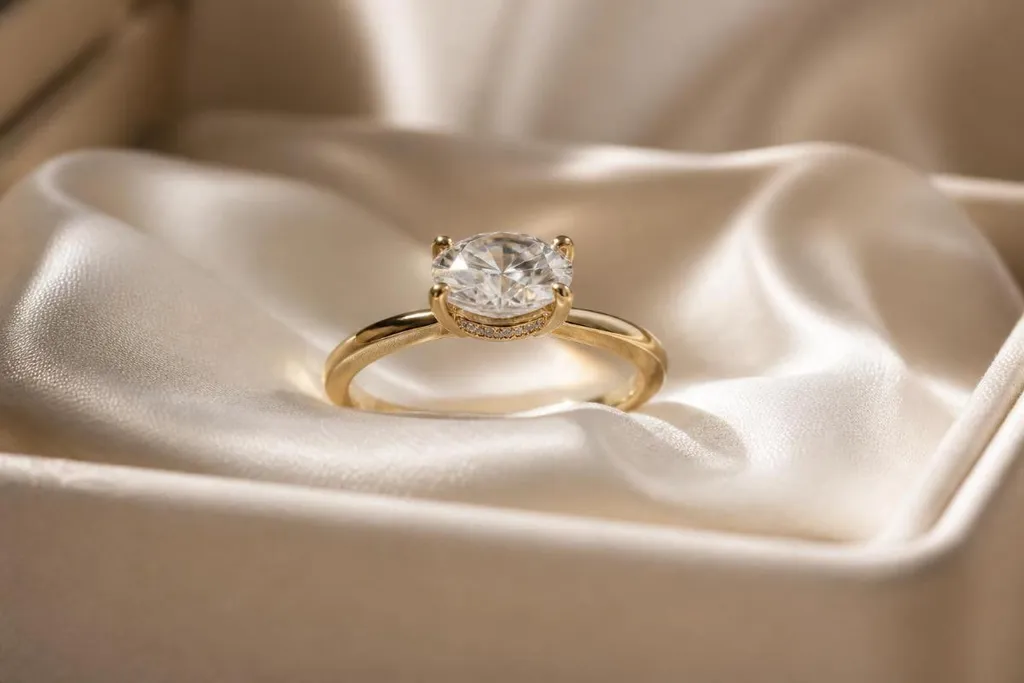
A traditional halo is designed to be seen, surrounding the centre stone with a border of smaller diamonds that increases its visual presence from above. A hidden halo takes a quieter approach. Positioned beneath the centre stone rather than around its face-up perimeter, it introduces additional brilliance into the side profile while leaving the primary silhouette largely unchanged. This makes it particularly appealing for someone who loves the clarity of a solitaire but wants a more detailed finish.
For an engagement ring that already has the right centre stone and overall proportions, this upgrade offers a way to introduce extra diamond detailing without turning the design into a conventional halo ring. The distinction is important: the centre stone remains the principal feature from above, while the added sparkle becomes visible through movement and alternative viewing angles.
How a Hidden Halo Differs From a Traditional Halo
The difference comes down to placement.
A traditional halo sits around the centre stone when viewed from above. Its smaller diamonds expand the visible outline, often making the central arrangement appear larger and more decorative.
A hidden halo is generally positioned below the centre stone, around the basket or gallery area of the setting. From a direct overhead view, it may be barely noticeable. Tilt the ring or look at it from the side, however, and the additional diamonds become visible.
That creates a different design experience. Rather than using smaller stones to increase the apparent face-up size, the hidden halo adds depth and detail to the ring's architecture.
This is especially effective for wearers who appreciate understated jewellery. A solitaire can retain its clean visual identity while gaining an element that feels more personal and intricate at close range.
Why It Works Particularly Well With Solitaires
Solitaire settings deliberately remove unnecessary visual competition around the centre stone. That simplicity is their strength, but some wearers still want a little more sparkle.
A hidden halo provides a useful middle ground.
Because the diamonds sit below the centre, they do not create a border around its outline. An oval still reads clearly as an oval, a round stone maintains its circular profile, and an emerald or radiant cut retains its strong geometry.
Stone size can influence how effectively the detail works. Someone choosing a 2-carat centre diamond, for example, may appreciate a hidden halo because the larger stone provides enough visual presence for additional detailing beneath it without making the overall design feel busy. The choice is not merely about adding more diamonds; it is about giving a substantial centre setting a more finished side profile.
A smaller centre can work beautifully too, provided the hidden halo is proportioned delicately rather than allowed to dominate the basket.
Metal Choice and Side-Profile Detail
The metal surrounding the hidden halo affects whether the additional sparkle feels seamless or deliberately contrasted.
Platinum and white gold create a bright setting around colourless diamonds. The small stones can visually blend with the metal, producing a continuous impression of light beneath the centre.
Yellow gold offers greater contrast. Small diamonds set against warm metal become easier to distinguish, giving the hidden halo a jewellery-like decorative quality even though it remains discreet from above.
Rose gold creates a softer contrast and can add warmth to an otherwise contemporary setting.
The height and architecture of the centre setting also matter. A hidden halo needs enough visibility to fulfil its purpose, but this does not mean the diamond should be raised excessively high. Good proportions should balance the side detail with comfortable everyday wear.
The complete ring should still feel cohesive rather than designed around a single upgrade.
Practical Considerations for Everyday Wear
Additional diamonds introduce additional settings, so care is important.
Soap, hand cream and other residue can accumulate around the small stones beneath the centre, particularly because the gallery is less exposed during routine cleaning. Gentle regular cleaning helps preserve the sparkle that distinguishes a hidden halo.
Professional inspections are also worthwhile. A jeweller can check the centre stone, prongs and smaller halo settings for wear or movement.
Wedding-band pairing deserves consideration as well. The position of the hidden halo and basket may influence how closely a straight band can sit against the engagement ring. Some designs allow a flush fit, while others naturally create a small space or suit a shaped wedding band.
Considering the future bridal stack before finalising the engagement ring can therefore prevent compromises later.
Final Thought
A hidden halo offers extra brilliance without fundamentally changing what makes a solitaire attractive. From above, the centre stone remains clean and clearly defined; from the side, a line of smaller diamonds introduces an unexpected layer of detail.
For someone torn between minimalism and additional sparkle, it provides an elegant compromise. The effect is intentionally subtle, proving that an engagement ring can become more intricate without becoming visibly more elaborate.